

In a recent courtroom showdown, Caroline Ellison, the former CEO of Alameda Research, provided key insights into the operations of FTX and its alleged improprieties. Her revelations, documented by Inner City Press correspondent Matthew Russell Lee, could play a critical role in the ongoing fraud trial against Sam Bankman-Fried, the former CEO of FTX.
Former Alameda CEO Caroline Ellison Dives Deep Into the FTX Debacle
On Thursday, U.S. District Judge Kaplan reminded Caroline Ellison of her oath, marking the beginning of a series of revelations about the inner workings of FTX. Mark Cohen, representing Sam Bankman-Fried, delved into specifics, asking Ellison about the “fiat account.” Ellison confirmed its existence, revealing that while she was uncertain about the exact number of sub-accounts, saying there were “at least dozens,” according to the X stream published by Matthew Russell Lee from the Inner City Press.
As the line of questioning progressed, Ellison was probed about her time at Alameda and her interactions with Sam Bankman-Fried. She conceded to Cohen’s assertions that she found some of Bankman-Fried’s claims to be accurate once she joined Alameda. When questioned about Bankman-Fried’s character, she stated he was “ambitious” and he encouraged her to adopt the same trait.

The dialogue took an interesting turn when Cohen broached the topic of Solana, the layer one (L1) blockchain Bankman-Fried championed. Ellison plainly admitted her lack of enthusiasm for it, a sentiment contrasting starkly with Bankman-Fried. The duo’s contrasting personalities were further highlighted when Ellison acknowledged their different reactions to stress and divergent fashion sensibilities.
The value of my holdings went down substantially due to market conditions but they are still tradeable. Can I take a deduction for the diminution in value without selling the coins so as to avoid trading costs? A. No. While for GAAP accounting purposes declines in market value are expensed on the financial statements, for tax purposes there must be a sale. But the good news is that digital assets currently are not subject to the ”wash sale” rules that securities are subject to, so if you still want to keep the investment, you can buy it back immediately and “harvest” a tax loss.
Does the loss realized include the highest fair market value of the digital asset (“DA”) less the selling price or is it limited to the actual cost of the DA? A. The loss is limited to actual cost. So if your cost was $1,000, the DA became worth $10,000, and now its worth only $500, your true deductible loss on sale is $500, not $9,500.
The exchange I entrusted to hold my DA is frozen and is the process of being liquidated. Meanwhile, I don’t have access to my DA but they have declined substantially in value and are still traded on other exchanges. Can I take a loss for the decline in my cost basis? A. Likely not as they are still traded on other exchanges and the fact that they are locked into the frozen exchange does not allow you to create a completed transaction to take your loss. You may have to wait till the liquidation finalizes and the DA is tradeable again to calculate your loss.
I loaned my DA to a Defi exchange to stake or lend onwards and now the DA have become worthless and are no longer tradeable. Can I take a tax loss on the loan? A. You may be able to take a non-business bad debt deduction for the loan which is treated as a short-term capital loss. Such a loss is deductible against ordinary income to a limit of $3,000 per year but deductible against other capital gains to no limit. Any carryover of loss is carried over forever until used. These rules are complex and your specific facts would need to be addressed.
I placed my DA into an exchange, and they became worthless just based on market conditions. They are no longer trading. Can I take a “worthless” security deduction for the loss? A. DA are treated like property for tax purposes, not like securities. As such, they have to be “sold or exchanged” to trigger the loss, unlike securities where a “worthless” designation would allow the loss.
The exchange I used to hold my DA closed due to a “hack” of its assets. It is in liquidation, and I may have to wait several years to recoup a fraction of my investment. Can I deduct my loss as a theft/casualty loss? A. This is a controversial area. If it is a casualty or theft loss that triggered the closing of the exchange, the Internal Revenue Code does not allow such losses presently under a law that is effective through 2025. If the previous law, allowing theft losses, becomes law again as scheduled, and that is when the loss is crystallized, you should be able to take the loss then.
When the Madoff Ponzi scheme was discovered, the IRS issued several Revenue Procedures in 2009 allowing for ordinary losses to be taken at varying percentages depending on certain factors. Why wouldn’t the current bankruptcies or “hacks” qualify for similar treatment? A. The Madoff theft losses were direct losses by investors who had placed money with him, which he embezzled. Also, theft losses were allowed as ordinary deductions at the time. Present “hacks” of an exchange where individual DAs are stolen would seem to qualify for a direct theft but theft losses are not currently deductible at all until the present law sunsets in 2025. Also, if general embezzlement or theft of an exchange’s assets lead to its demise for lack of capital but there is not a direct link to the theft of assets of an individual, that is not considered a “theft” loss. These rules are complicated and each set of facts must be examined to determine what tax law might apply to allow some current tax loss.
The discussions grew tense as Cohen introduced various exhibits and statements, met with objections from the prosecution, questioning their relevance. In a notable moment, Ellison expressed her concerns about Alameda potentially jeopardizing FTX customers’ funds. She revealed that she had shared these concerns not only with Bankman-Fried but also with other colleagues, namely Gary Wang and Nishad Singh.
Cohen’s cross-examination took a financial turn when he asked about Ellison’s attempts to hedge financial risks in September 2022. Ellison recounted her calculations, suggesting that billions should be sold to hedge, but also admitting to the uncertainty of the situation. A significant revelation came when she mentioned a loss of $100 million due to the depreciation of UST, an algorithmic coin tied to Luna and the Terra blockchain.

In the final moments before the lunch break, Cohen touched upon an alleged bug in the system, and Ellison detailed the bug was discovered in May. The line of questioning, led by Bankman-Fried’s lawyer focused on Alameda’s financial intricacies. He probed Ellison about Alameda’s liquid assets, to which she confirmed the company’s lack thereof. A significant revelation was made when she disclosed Alameda’s repayment of “$5-10 billion” in the summer, with “$5 billion” being repaid just in June.
As 2021 comes to an end, it is crucial for investors in cryptocurrency (“crypto”) to revisit their portfolios and the capital gains they have realized during the year. Unlike stocks, where wash sale rules prevent a taxpayer from selling a security at a loss and immediately buying that same stock back, currently, no such rule applies to crypto, as the IRS classifies crypto as property and not a security.
The current wash sale rules regarding securities preclude investors from claiming a deduction when they sell a security at a loss if they buy a “substantially identical” asset within 30 days before or after the sale.
This current loophole for crypto investors is scheduled to end if the “Build Back Better Act” is passed by the Senate and signed into law (the U.S. House of Representatives passed the bill on November 19, 2021). According to the Joint Committee on Taxation, it is estimated that subjecting crypto to wash sale rules would raise $16.8 billion over the next decade.
Given the potential change to the wash sale rules, it will be important to review your holdings and trading activities to capture losses to offset gains from the current year, as the window to do so may be quickly closing.
*As of February 2022, with Build Back Better legislation in limbo, there is no outcome yet for this wash sale rule loophole.
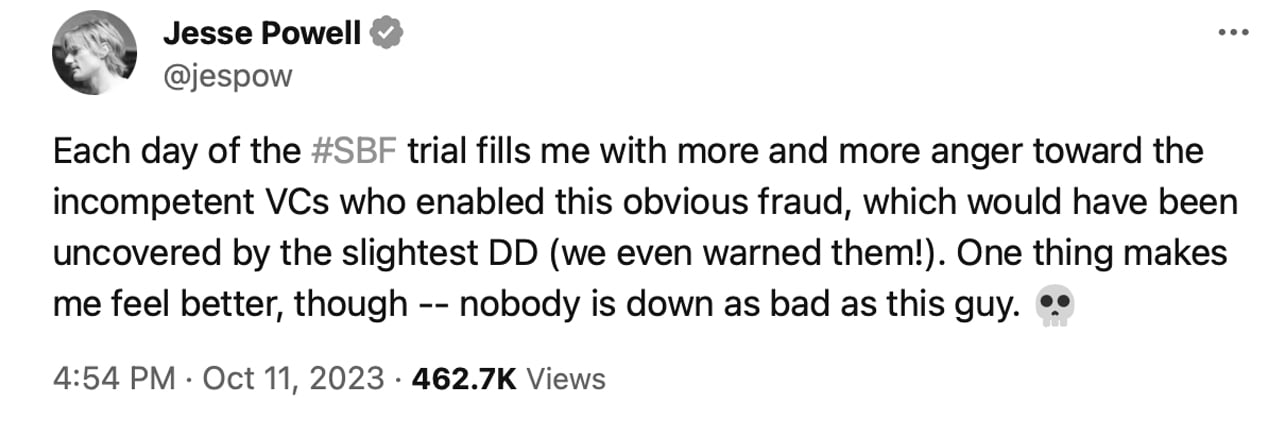
Cohen’s examination took a deeper dive into specific exchanges between Ellison and various entities. Discussing her communication with Genesis on June 18, Ellison revealed it revolved around “sending the balance sheet” and that there were “eight” versions of it. A particularly noteworthy quote emerged when she was questioned about third-party loans.
“It might look like Alameda was funneling money to FTX executives,” Ellison candidly shared. The narrative further unwound as Cohen brought up Bankman-Fried’s attempts to raise money from a Saudi prince, and Ellison’s skepticism of FTX’s potential investment in a company named Modulo.
Towards the end, Cohen referenced a tweet by Ellison, where she claimed that Alameda had returned most of its loans. Ellison clarified, stating, “Not really. We returned third party loans, by taking out more loans from FTX.” As the discussion shifted to an all-hands meeting in Hong Kong, Ellison mentioned that Sam Bankman-Fried had hinted at starting a new company.
The cross-examination concluded with a significant admission by Ellison, confirming that she had indeed informed employees about alleged wrongdoing within the company. In a riveting turn of events, a re-direct by government prosecutors centered on pinpointing the individuals involved in the alleged malfeasance.
When questioned about who was involved in the purported wrongdoing, Ellison unhesitatingly responded, “I said Sam, Gary, Nishad and I – and that the decision to repay loans with customer funds was Sam’s.” As the inquiry delved deeper into her motivations for disclosure, Ellison poignantly remarked, “We had already failed. So I could,” Russell Lee’s account of the situation detailed.
At the end of the testimony, Bankman-Fried’s lawyer claimed Caroline Ellison “went beyond the scope of the agency.” The Federal prosecutors responded that “Ms. Ellison said she would always defer to Sam. Here Mr. Bankman-Fried was aware she was going to have this meeting. He did not seek to remove her [as] CEO – instead, he provided input. So she was his agent.”
What do you think about Ellison’s testimony against Bankman-Fried? Share your thoughts and opinions about this subject in the comments section below.